You have probably seen the same fragrance available as an EDT, EDP, Parfum or Extrait.
The obvious assumption is that they are simply different strength levels of the same scent.
Sometimes that is true.
Very often, it is not.
Concentration can affect how a fragrance smells, how long it lasts and how it develops on skin. But an EDP is not automatically a stronger version of the EDT, and an Extrait is not automatically the best version.
Here is what the labels actually mean.
What Does Fragrance Concentration Mean?
Fragrance concentration refers to how much fragrance material is used in the finished formula.
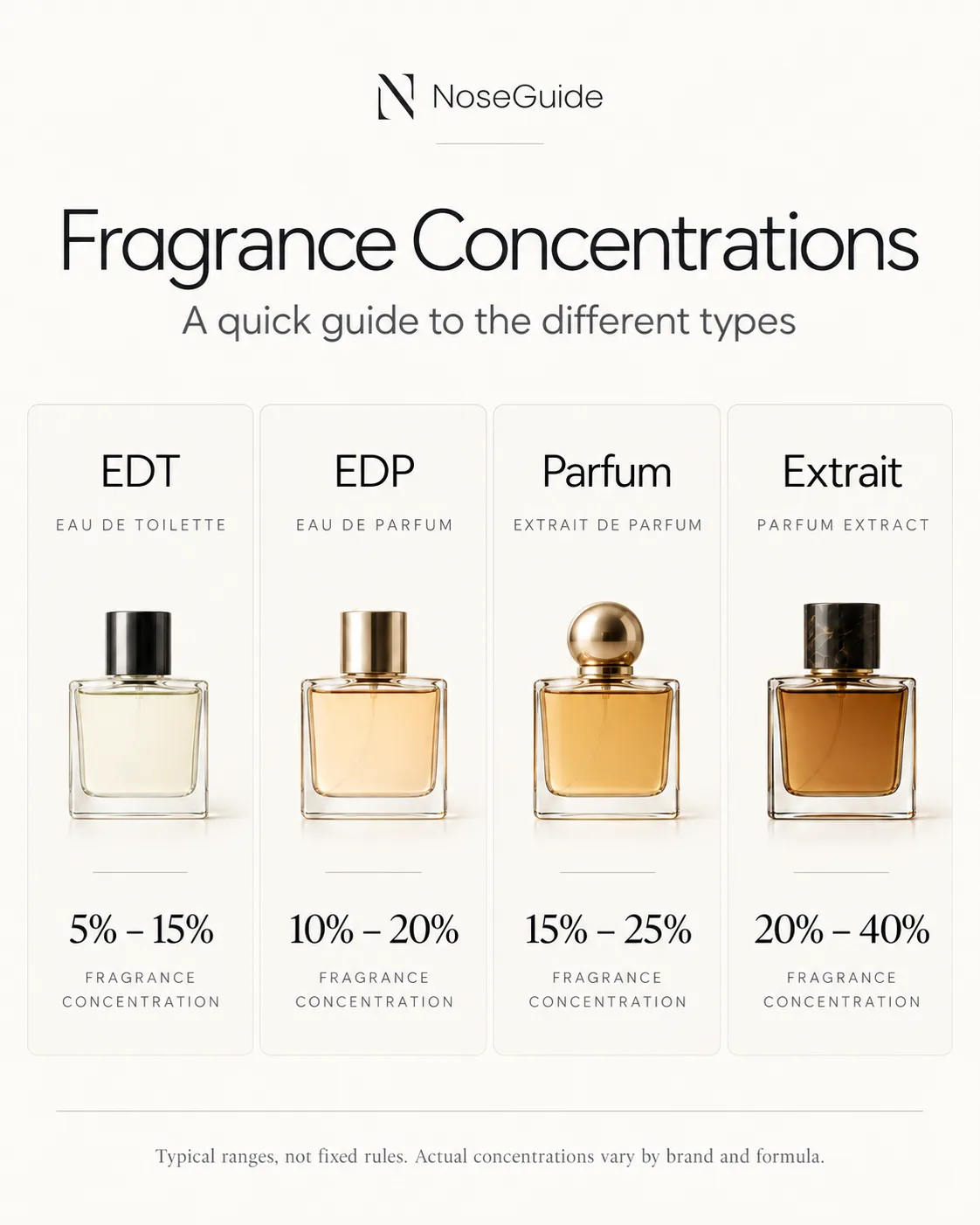
As a general guide:
| Type | Typical concentration |
|---|---|
| Eau de Cologne | 3% to 8% |
| Eau de Toilette | 5% to 15% |
| Eau de Parfum | 10% to 20% |
| Parfum | 15% to 25% |
| Extrait de Parfum | 20% to 40% |
These are typical ranges, not strict rules.
Brands formulate differently and the ranges can overlap.
That is why the concentration name should be treated as a useful guide, not an exact measurement.
Eau de Toilette, EDT
An Eau de Toilette usually sits on the lighter side of the concentration scale.
EDTs often feel fresher, brighter and more transparent, especially in the opening.
Citrus, aromatic notes, herbs and fresh woods can feel particularly lively in this format.
But do not confuse lighter concentration with poor performance.
There are EDTs that project strongly and last for hours.
And sometimes the EDT is simply the best version of the fragrance.
Eau de Parfum, EDP
An Eau de Parfum usually contains a higher fragrance concentration than an EDT.
It can feel fuller, smoother or richer and often lasts longer.
But this is where one of the biggest misunderstandings begins.
An EDP is not always the EDT with more perfume added.
The formula can change.
The brand might increase the woods, amber, vanilla or florals, reduce some of the brighter notes and completely change the balance of the fragrance.
So if you love an EDT, do not automatically assume you will prefer the EDP.
Smell both.
Parfum
Parfum usually sits above EDP in concentration.
These versions often feel denser and smoother, with more attention given to the heart and base of the fragrance.
You may notice less brightness in the opening and more woods, amber, musk, vanilla or resins as the scent develops.
But again, there is no rule saying every Parfum has to smell this way.
Some brands use the Parfum version to create a completely different interpretation of the original fragrance.
Extrait de Parfum
Extrait de Parfum is usually one of the highest concentration formats.
It can feel rich, dense and very smooth on skin.
Extraits can also have excellent longevity.
What they do not automatically have is huge projection.
A concentrated fragrance can stay on your skin for a very long time while creating a smaller scent cloud around you.
That is why longevity and projection should never be treated as the same thing.
Parfum vs Extrait: What Is the Difference?
This is where things become less clear.
There is no universal rule that separates Parfum from Extrait de Parfum.
One brand may call its highest concentration Parfum.
Another may call it Extrait.
Some brands offer both.
So you should not assume that an Extrait from one house is automatically stronger than a Parfum from another.
The actual fragrance matters more than the wording on the bottle.
Does Higher Concentration Last Longer?
Often, yes.
But not always.
Higher concentration can help a fragrance stay noticeable on skin for longer, but performance depends on much more than concentration.
The materials used matter.
The structure of the fragrance matters.
Even the balance between the opening, heart and base matters.
A fresh EDT can sometimes perform better than a softer EDP from another fragrance.
The label alone cannot tell you how many hours something will last.
Does Higher Concentration Mean Stronger Projection?
No.
This is probably the most common mistake people make.
A fragrance can have excellent longevity and moderate projection.
Another can project strongly for the first couple of hours and then become much quieter.
So when someone says a fragrance is “stronger”, it helps to ask what they actually mean.
Does it last longer?
Does it project further?
Does it smell richer?
Does it feel denser?
Those are different things.
EDT and EDP Can Smell Completely Different
This is especially important when buying online.
Imagine you love the EDT of a fragrance.
You see the EDP and think:
Same fragrance, stronger version.
You buy it.
And it smells noticeably sweeter, darker or more woody.
That happens because brands often change the composition between versions.
The opening may change.
The sweetness may change.
The drydown may change.
Sometimes even the main character of the fragrance changes.
Always compare the exact version you are interested in.
Is EDP Better Than EDT?
No.
And Parfum is not automatically better than EDP either.
Higher concentration is not a quality ranking.
Sometimes a fragrance needs the brightness of an EDT.
Sometimes the richer EDP works better.
Sometimes the Parfum is the standout version.
And sometimes the original is still the best.
It comes down to the fragrance itself.
Which One Should You Choose?
There is no single answer, but this is a useful starting point.
Choose an EDT if:
You prefer fresher and lighter fragrances.
You want something easy to wear during the day.
You enjoy a brighter opening.
You simply prefer how the EDT smells.
Choose an EDP if:
You want a little more depth.
You prefer a fuller scent profile.
You want something that may stay noticeable for longer.
Choose a Parfum if:
You enjoy richer and smoother compositions.
You prefer more emphasis on the drydown.
You like warmer, deeper versions of a fragrance.
Choose an Extrait if:
You enjoy dense and highly concentrated fragrances.
You care more about depth and longevity than a huge opening projection.
You have actually smelled the Extrait and prefer it.
The most important thing is simple:
Choose the version you like, not the one with the highest concentration.
What About Eau de Cologne?
Eau de Cologne generally has a lower concentration than EDT.
It is traditionally associated with fresh citrus, herbs and lighter compositions.
These fragrances are usually designed to feel bright and refreshing rather than dense or heavy.
Just remember that some brands also use the word “Cologne” as part of a fragrance name, so it does not always tell you the exact concentration.
Quick Comparison
EDT
Typical concentration: 5% to 15%
Usually lighter and fresher.
EDP
Typical concentration: 10% to 20%
Usually fuller and richer.
Parfum
Typical concentration: 15% to 25%
Often smoother and denser.
Extrait de Parfum
Typical concentration: 20% to 40%
Usually one of the most concentrated formats.
These ranges overlap and brands do not all follow exactly the same system.
The One Thing to Remember
Do not look at EDT, EDP, Parfum and Extrait as four levels from worst to best.
Think of them as different versions of a fragrance.
Sometimes the difference is mainly concentration.
Sometimes the formula changes as well.
And sometimes the version with the lower concentration is the one you will enjoy most.
If possible, smell the exact version before buying.
FAQ
What is the difference between EDT and EDP?
EDP usually contains a higher fragrance concentration than EDT and may feel richer or last longer. However, the two versions can also use different formulas and smell noticeably different.
Is EDP better than EDT?
No. EDP has a higher typical concentration, but that does not make it a better fragrance.
Which lasts longer, EDT or EDP?
EDP often lasts longer, but this depends on the individual fragrance and its formula.
Is Parfum stronger than EDP?
Parfum is usually more concentrated, but that does not guarantee stronger projection.
Is Extrait stronger than Parfum?
Not always. The terms and concentration ranges can overlap depending on the brand.
Does Extrait de Parfum last the longest?
It often has very good longevity because of its high concentration, but performance still depends on the formula.
Can EDT and EDP smell different?
Yes. Brands often adjust the composition rather than simply increasing the concentration.
Which fragrance concentration should I buy?
Choose the version whose smell and performance you prefer. Do not choose only by concentration.
Find the Version That Works for You
Comparing different versions of the same fragrance?
Search NoseGuide and make sure you are looking at the exact EDT, EDP, Parfum or Extrait before choosing your next bottle.